Sporting Glory and the Six Nations Trophy
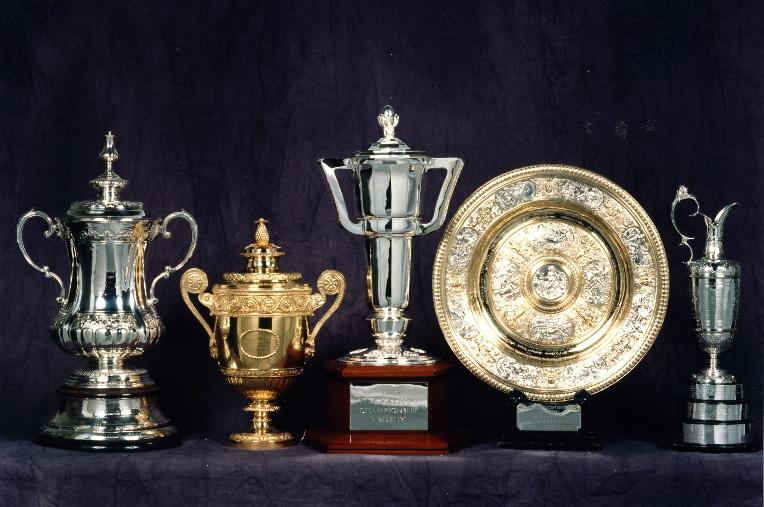
|
The FA Challenge Cup |
The Wimbledon Gentlemen's Singles Cup |
The Five Nations Championship Trophy |
The Ladies' Singles Challenge Plate |
The British Open Claret Jug |
|
During the research for the Sporting Glory exhibition, it was established that the only major national sporting competition that did not have a trophy was the Five Nations Rugby Championship. Lord Burghersh, organiser of the exhibition, had the idea of producing a Five Nations Trophy. He approached the Five Nations Committee with the proposal that he would commission the design and production of the new Trophy to feature as the centrepiece of his exhibition. At the end of the exhibition, it would be presented to the Committee.
Lord Burghersh’s only wish was that although the Championship might become sponsored, the Trophy itself would not have a sponsor’s name engraved on it, and that it would continue to be used as the Championship expanded and new nations were included. This would enable it to become as established and famous as the other great trophies exhibited in his Sporting Glory exhibition.
|
|
The Five Nations Committee approved the idea and at the same time agreed to devise a formula based on points differences to determine an outright winner for the Trophy each year. |
TROPHY DESIGN
 The Trophy was designed by James Brent-Ward, Designer and Managing Director of the London Silversmiths, William Comyns, who produced it.
It has fifteen sides – one for each player. It has three handles one for each official – the referee and the two touch judges - and the handles are large enough to make lifting the Trophy easy. It has a lip at the rim of the cup, designed so that it is easy to drink from, and the capacity of the Trophy is exactly five bottles of Champagne, one for each of the original five competing nations. The Trophy eventually became so tarnished with frequent drinking of champagne by winning teams, that eventually it had to be lined with 22 carat gold to protect it.
The handle, or finial, on the lid is interchangeable and represents the current champions. The finials of the challenging teams are kept in a hidden drawer inside the plinth throughout the Championship. It also has the emblem of each nation around the base. These are fixed in such a way that they can be moved to accommodate the addition of new emblems when new nations join, as happened when Italy joined in 2000 and the Trophy was renamed ‘ The Six Nations Championship Trophy’.
|