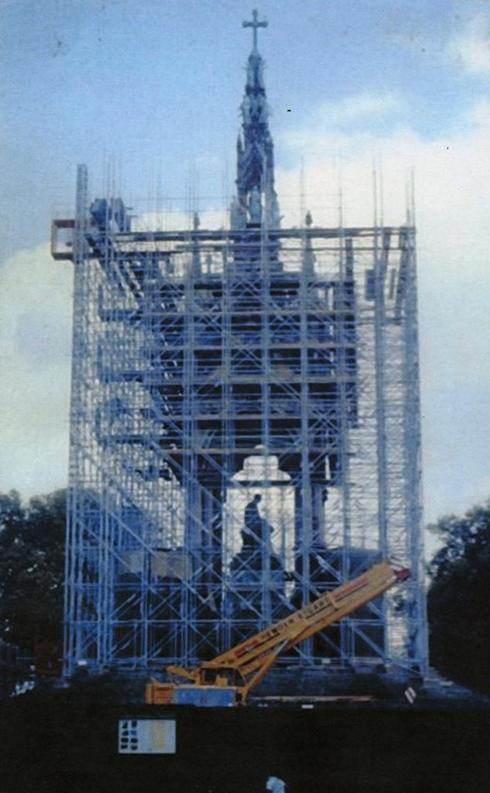
Following the death of Prince Albert in 1861, a competition was held to choose a design for the Prince’s National Monument. Queen Victoria chose the design submitted by George Gilbert Scott, and work on the Albert Memorial began in 1864. The structure was completed in 1872, and the large bronze statue of Prince Albert was finally placed in position in 1876.
A hundred years later, however, the fabric of the Memorial had begun to decay, and debates about its future seemed unable to produce a practical solution. In April 1983 the situation took a dramatic turn for the worse when '... a large, heavy piece of lead cornice came crashing to the ground, and struck terror into the hearts of those responsible for the Memorial'. The Memorial and the surrounding area were immediately closed to the public. In 1987 an official report included 'demolition' as one of the options for its future, and three years later, in 1990, work began installing the largest free-standing scaffolding in the world, completely covering the Memorial and hiding it from view.
Arguments in favour of its restoration mostly centred on the Memorial's aesthetic merits. What seemed to catch the public’s imagination, however, was not information about the Memorial itself, but about its relationship to the Great Exhibition of 1851. First, almost without exception, people did not realise that the Crystal Palace had originally been built, not at Sydenham in South London, but in Hyde Park. Secondly, the £186,000 profit from the Exhibition had been used to buy the land to the south of the Memorial, which became known as Albertopolis, and now includes, among other cultural and educational institutions, the Royal Albert Hall, Imperial College, and the Victoria and Albert Museum. And, lastly, the Memorial has as its centrepiece the huge gilded statue of Prince Albert gazing south across Albertopolis, and holding in his hand a copy of the catalogue of the Great Exhibition.
|